The Amazons were a legendary society of fierce warrior women originating from an undefined area that Greek writers often vaguely placed near the edges of the known world, typically ranging from Scythia (the region north of the Black Sea, encompassing modern-day Ukraine) through the Caucasus Mountains and into the Anatolian peninsula (modern-day Turkey). Various Greek authors, from the historian Herodotus to the tragedian Aeschylus, wrote about them, placing the Amazons in a fascinating, intermediate dimension between history and myth.
Society and Military Prowess
Their highly structured society was often depicted as being a matriarchy ruled by two co-queens:
A "queen of peace" (or domestic queen) who managed internal affairs and administration.
A "queen of war" who dedicated herself to military campaigns and external defense.
Amazon education focused heavily on skills necessary for survival and conquest, including warfare, archery, and hunting. As skilled fighters, the Amazons were known for their mastery of both cavalry and foot combat. Their arsenal was diverse, including the bow and arrow (for which they were famously skilled), the pelta (a light, crescent-moon shaped shield), and the labrys (a double-headed axe).
The role of men in Amazon society is perhaps the most mysterious and contradictory part of the legend. According to various sources:
Some myths claim all male infants were expelled or sent to a neighboring, all-male tribe known as the Gargareans, with whom the Amazons would periodically meet for procreation, keeping only the female children.
Other traditions suggest men were kept within Amazonian borders but occupied subordinate positions as servants, laborers, or slaves, essentially reversing the traditional gender roles of Greek society.
Conflicts with Greek Heroes
The Amazons were traditionally portrayed as formidable enemies of the Greeks, symbolizing the wild, uncivilized, and powerful "other" existing beyond the Hellenic world. They appear twice in Homer’s Iliad, notably when the hero Bellerophon fights a great battle against them.
Their most significant mythological role, however, involves the Trojan War.
The Amazons were called as allies by King Priam of Troy toward the end of the conflict.
They were led by their fierce and noble queen, Penthesilea. This myth was primarily narrated in the lost epic poem, the Aethiopis, attributed to the poet Arctinus of Miletus.
The Tragedy of Penthesilea
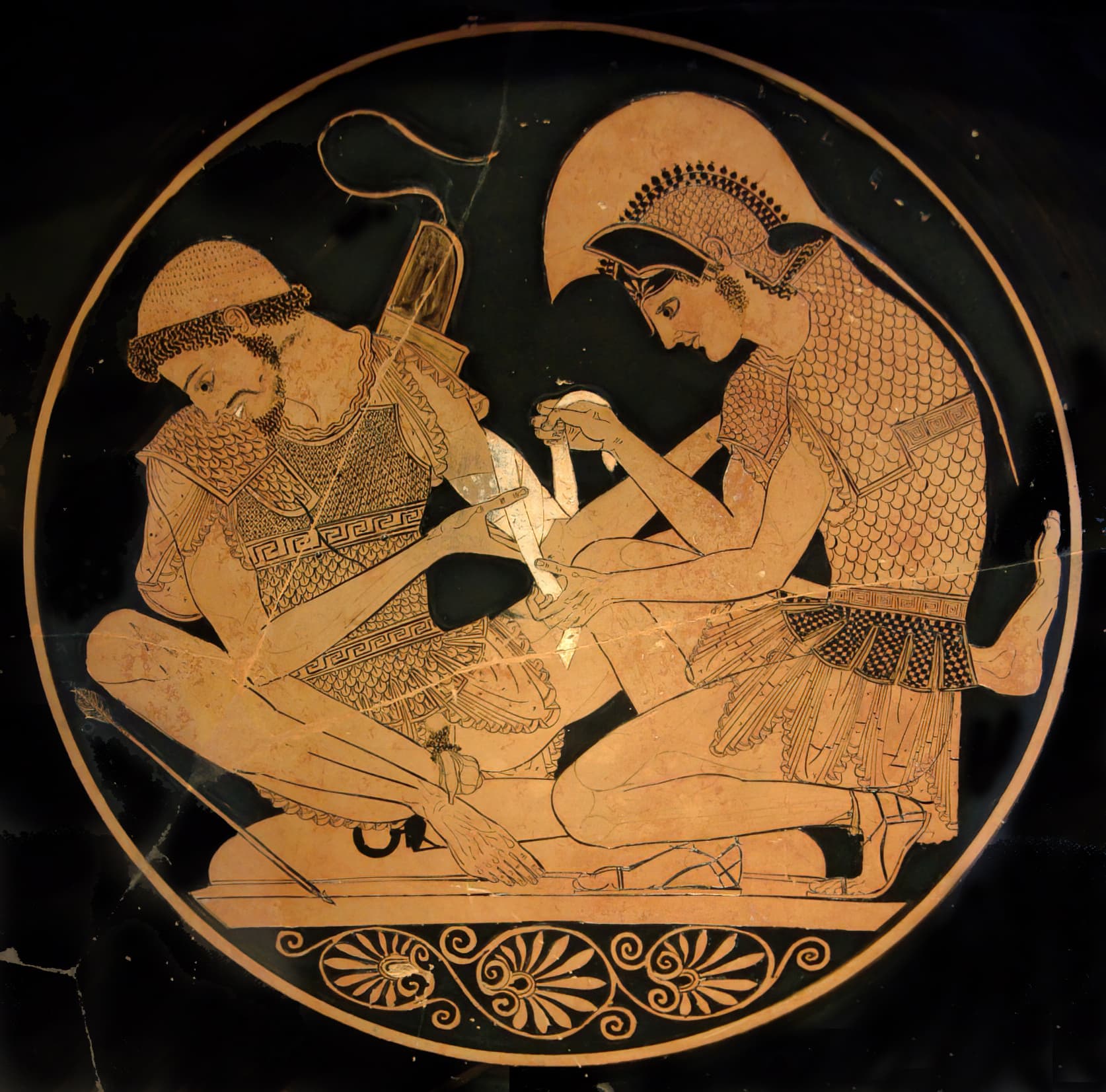
Upon entering the war, Queen Penthesilea proved to be a formidable opponent. The climax of her story is a tragic, one-on-one duel with the Greek champion, Achilles. Penthesilea was ultimately slain by the hero. According to the legend, as Achilles removed her helmet, he was immediately struck by her beauty, courage, and bravery, realizing too late that he had killed someone he could have admired or even loved. Her death determined the Amazonian defeat and withdrawal from the Trojan War.